
Chalkbeat: Work first, college degree later – Indiana wants students to consider a new postsecondary model
This story was originally published by Chalkbeat. Sign up for their newsletters at ckbe.at/newsletters.
Driving a school bus allowed Carly Kendall to see her daughter off to school every day, while balancing her service in the National Guard.
But once her daughter was older, Kendall wanted to start a career. She found one via an apprenticeship program for veterans at First Merchants Bank that allowed her to leverage her military experience in HR. This month, Kendall was promoted to a role overseeing the bank’s apprenticeship programs, including a new one led by the Financial Services Academy that’s rolling out in 20 Indiana high schools this fall.
Kendall said banks are well-suited to guide students through apprenticeship pathways because they offer a variety of roles and departments, as well as room for growth.
“You expect that you’re going in there to deposit your checks and get money out,” said Kendall, who’s also pursuing associate and bachelor’s degrees. “With the apprenticeships, the goal is that they’ll see there are so many different opportunities.”
Training on the job is also the foundation of Indiana’s new vision for postsecondary education. The state’s goal is to help more students land high-paying jobs without debt in fields that are projecting workforce shortages, such as manufacturing and healthcare.
Instead of going directly to college, the state wants more students to immediately enter the workforce through apprenticeship and internship programs that they begin in high school. Their employers would not only pay to train those students for entry-level jobs, but also possibly for continuing education, like credentials or training that could lead to promotions. Degrees would come later — as a means of advancement, rather than a prerequisite for employment.
Indiana is considered a national leader in this approach, as more employers seek workers with specific skills and training, said Taylor White, director of postsecondary pathways for youth at New America’s Center on Education and Labor.
But the state’s vision requires buy-in from students, families, and employers. While there’s bipartisan support for apprenticeship, in practice, these models have struggled to attract the thousands of students they promise. And not every industry is prepared to hire students who don’t have college degrees.
Indiana officials think the state can do better. This school year, schools and employer associations will launch the first Indiana Career Apprenticeship Programs, or INCAP, to train high schoolers and adults for jobs in fields like banking, construction, and advanced manufacturing.
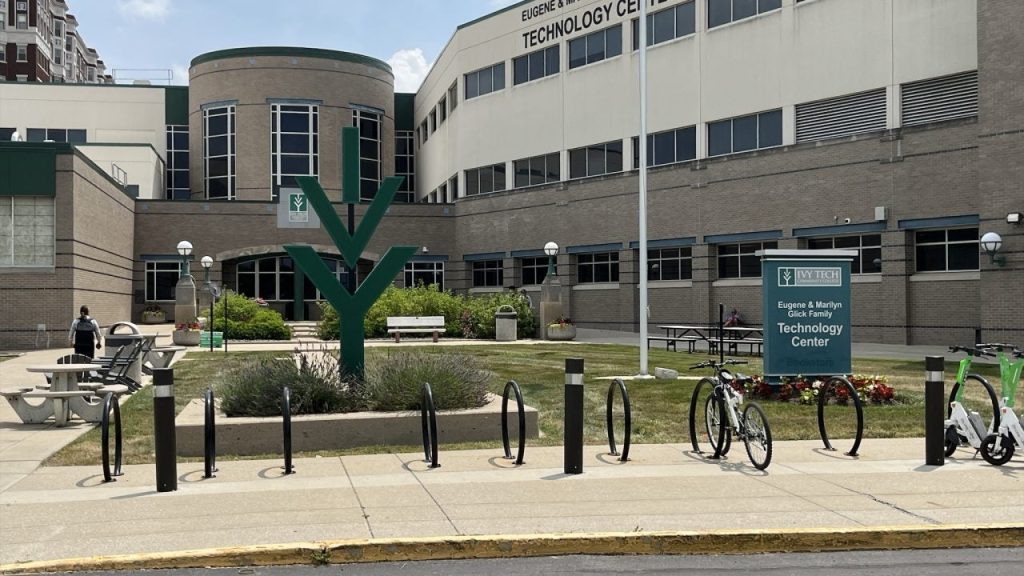
This launch dovetails with a new mission for Ivy Tech Community College that will focus on workforce development and growing more programs that are paid for by employers.
To support these initiatives, the state is also pursuing a new framework to ensure that students who get workforce training can go to college later — akin to passing a baton in a relay race, said Secretary of Education Katie Jenner.
“How can we ensure we’re not dropping as many batons as we’re dropping today?” Jenner said. “What does that handoff look like so that students can … be on a path that makes sense for them?”
First, help students graduate directly into the workforce
Since the state approved new graduation requirements in 2024, Indiana high schools have been ramping up programs that allow students to earn work experience.
INCAP adds to those offerings through paid two- and three-year apprenticeships in which students spend several days every week training on the job with an employer. The curriculum is developed by one of INCAP’s Industry Talent Associations, which are made up of businesses in fields like construction, advanced manufacturing, and healthcare.
“The big differentiator for these INCAP programs is that they are developed by industry, and so they are reflecting what Indiana employers say that they need today and think they’re going to need down the road,” said Claire Fiddian-Green, president and CEO of the Richard M. Fairbanks Foundation, which is funding and leading the development of INCAP.
Students who complete the INCAP high school pathway will earn the state’s new Employment Honors Plus seal on their diplomas, as well as the INCAP Apprenticeship Program credential
— which INCAP envisions as being transferable not just to other employers, but to state universities, much like advanced coursework.
In the banking pathway, high school apprentices will earn a retail banking certificate, allowing them to immediately compete for the same jobs that a recent college graduate is applying for, said Chris Fisher, CEO of the Financial Services Academy. (Kendall oversees INCAP at First Merchants Bank.)
After graduating high school, students can also stay in the INCAP pathway and earn a degree that’s equivalent to a four-year college degree, said Fiddian-Green.
These new degrees will derive their equivalency from the Indiana Qualifications Framework, a forthcoming system that will categorize every degree and credential program in the state into levels that show what skills students have.
The framework is Indiana’s answer to questions about how students who enter apprenticeships and career-training programs will get recognition for their skills from other employers, or transfer them to colleges and universities later.
“We want to make sure that we’re not creating a pathway where there are dead ends,” Fiddian-Green said.
Nationally, more employers are touting this kind of skills-based hiring, said White of New America.
In some industries like healthcare or advanced manufacturing, that’s relatively straightforward, White said. But in industries where skills are less technical, the transition has been less smooth.
“Companies say that’s a great idea, and we’re on board, but the data says they’re hiring people with bachelor’s degrees anyway,” White said.
Later, help workers get a degree without debt
Starting work first likely doesn’t mean skipping college entirely.
Under Indiana’s plan, students could earn a degree later — and their employers might pay for them to do so.
A good degree pathway for older students would give them credit for work experience, said Beth Doyle of the Council for Adult and Experiential Learning. Without that, returning students can find themselves in classes for skills they already have, potentially adding years to their education and making it more difficult to earn the credential.
Tuition paid upfront by an employer also helps with costs — the biggest barrier to higher education for many students, Doyle said.
“As things accelerate technologically and in other ways, people are going to need ongoing training, and we can’t assume that they’re going to leave high school knowing what they want to do for the rest of their life,” Doyle said.
White, of New America, said research suggests that young people are increasingly skeptical of a four-year degree, but more open to shorter courses of postsecondary education.
“None of us think you don’t need any college at all — that’s naive,” White said of researchers studying the future of work. “Apprenticeship, when linked well, can be a sort of different route into postsecondary education that allows young people to get different skills before they’re asked to make very expensive and consequential decision.”
A new mission for Ivy Tech Community College could play a role alongside INCAP’s apprenticeship credentials.
Earlier this year, lawmakers codified Ivy Tech’s role as the “workforce engine” of the state.
College leaders say that means aligning existing programs to employer needs, as well as expanding Achieve Your Degree programs, in which companies pay upfront for their employees to take approved courses that can lead to a degree from Ivy Tech.
The program is not new — Cook Medical, a manufacturing company, has sponsored more than 500 Ivy Tech students through its AYD partnership since 2016, with around 127 earning credentials. But college leaders see more students taking this path as a way to make postsecondary education more affordable and meaningful.
“I don’t think the future of college is necessarily this linear pathway of two years, then four years. I think it can be students wanting to get those stackable credentials, get into the workforce, make some good wages, possibly continue on at Ivy Tech with an associate’s degree, and then somewhere down the road, a bachelor’s degree,” said Martin Pollio, Ivy Tech’s president.
At least some schools with a college preparatory focus are trying to balance both.
Herron-Riverside High School, a college preparatory charter school in Indianapolis that focuses on classical education, is launching a workforce training partnership with Vincennes University in fields like aviation, welding, cybersecurity, and advanced manufacturing. The school is also part of the Riverside Education District, which is in the midst of a $137 million investment in career training and literacy.
Head of school Emanuel Harper doesn’t see career training as contrary to the school’s classical education philosophy of helping students to understand culture and history in order to become productive members of society, Harper said.
“One of the ways to do that is to go to college to continue to deepen one’s understanding of self and society,” said Emanuel Harper, Herron-Riverside’s head of school. “Another even more immediate way to be a productive member of society is to go to the workforce to apply those skills … in the career field.”
Aleksandra Appleton covers Indiana education policy and writes about K-12 schools across the state. Contact her at aappleton@chalkbeat.org.
About The Author

You may also like
-
2 juveniles critically hurt in shooting at housing addition on east side
-
Dolly Parton, legendary songwriter, singer and actor, has died
-
WIBC traffic reporter Matt Bair dies at 48
-
‘No resolution’: Advocates, lawmakers call for change after state’s $625K settlement with ex-IURC regulator
-
2 hurt in crash of 2 semis and 2 school buses that shut down I-70