
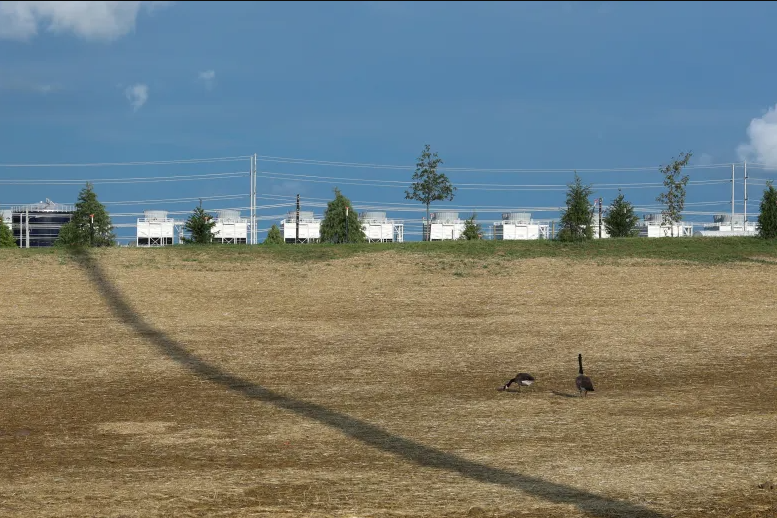
(FREE PRESS INDIANA) — Some of the largest data centers under construction in Indiana have avoided more extensive environmental scrutiny, public input and costs associated with restoring wetlands.
That’s because the projects were not required to get a federal water permit after a U.S. Supreme Court decision in 2023 narrowed the scope of the Clean Water Act, the landmark 1972 legislation that protects and restores surface water.
The ruling removed federal oversight of around half of all the nation’s surface waters.
Five data center developments in Indiana contain wetlands, streams or ponds that, before the court ruling, would have fallen under the jurisdiction of the law and required a federal permit, according to a POLITICO analysis.
Now, the Indiana Department of Environmental Management is the only agency overseeing the surface water impacts at those sites.
Wetlands are needed to protect and improve water quality, provide fish and wildlife habitats, store floodwaters and maintain surface water flow during dry periods.
Without a federal permit, the data centers avoid the process that requires extensive public input — including public comments, a hearing and federal comment review — and scrutiny from the Army Corps of Engineers, which oversees the federal program.
The federal process also poses the real possibility that the permit may be denied, according to David Van Gilder, senior policy and legal director with the Hoosier Environmental Council.
“If I own and want to develop land on which there is a federally regulated wetland, I’m going to have to jump through a lot more hoops,” he said. “If I’m sitting on that same land now under (IDEM), I can breathe a lot easier because I’m going to get a permit, almost 100% assured, from the state of Indiana.”
A tale of two data centers
Two massive data centers currently under construction in Indiana highlight how the process changes when a federal permit is required.
Project Rainer, the 1,200-acre Amazon data center campus in New Carlisle in northwest Indiana, includes wetlands and streams regulated by the Clean Water Act.
The first federal application filed by the company requested authorization to fill in nearly 10 acres of wetlands in order to build the campus. The Army Corps responded by requesting another plan with less impact.
Amazon is now proposing to fill in around 5 acres of wetlands, but create around 10 acres of new wetlands in the southeast corner of the site to make up for the lost land. The permit is still under review.
At Project Zodiac, the nearly 900-acre Google campus in Fort Wayne, an inspection determined the first two construction phases at the site didn’t contain any federal waterways, placing jurisdiction with IDEM.

The state agency determined the project area contained nearly 12 acres of wetlands, but just 2.4 acres under state jurisdiction would be impacted by the development. Another 2 acres were considered exempt, allowing the company to fill them in without any permit.
IDEM required Google to mitigate the loss by purchasing credits through a program administered by the Indiana Department of Natural Resources to restore around 4 acres of wetlands in other parts of the state.
However, the Army Corps in July determined the state program to be out of compliance because it wasn’t restoring wetlands in the federally mandated three-year timeframe. The program has collected at least $109 million in wetlands payments from developers, but has only fully completed two projects.
“I think there’s an open question about whether it’s reasonable or arbitrary and capricious for our agency to accept (mitigation credits) even though the federal government says the program isn’t good enough anymore,” Van Gilder said.
Mark Becker, the IDNR’s land acquisition division director, told the Indiana Capital Chronicle the main reason for the backlog comes from complex regulatory hurdles and lengthy review timelines to begin implementing wetland mitigation projects for which developers can buy credits.
He said the agency is building a “robust pipeline” of 27 mitigation projects in various stages of development to reduce the backlog.
Indiana loosens wetland protections
The court decision narrowing the Clean Water Act is impacting other states beyond Indiana. At the time of the ruling in 2023, nearly half of all 50 states had no state-level regulations or permitting process for wetlands.
Indiana law for decades has required reviews, permits and mitigation efforts that, in some ways, closely mirror federal regulations.

But those state standards in 2024 were significantly reduced by House Enrolled Act 1383, which completely removed some wetlands from state oversight and reduced regulations on other protected wetlands.
Kim Ferraro, managing attorney at the Conservation Law Center based in Bloomington, said the law “gutted” the state’s wetland program, leading to “very few” wetlands receiving protection from either state or federal laws.
“Now they can just fill them, and they don’t have to replace the damage that they caused,” she said.
FPI News, a nonprofit newsroom, is funded through grants and donations from individuals, foundations and organizations. Sign up for our free newsletter.
FPI News reporter Carson Gerber covers healthcare, manufacturing, agriculture, immigration … and just about any other topic that’s shaping how we live in Indiana today. Reach him at 765-204-4250 or carson.gerber@fpinews.org.
About The Author

You may also like
-
IU basketball defeats Butler 96-68 in exhibition at Hinkle Fieldhouse
-
Sister seeks answers one week after west side hit-and-run kills identical twin
-
Police: Man accused of stabbing parents to death on Indy’s north side
-
Hundreds honor Yorktown football star Chris Wilson Jr. at high school stadium
-
Man in ‘extremely’ critical condition after being hit by car on Indy’s northeast side