
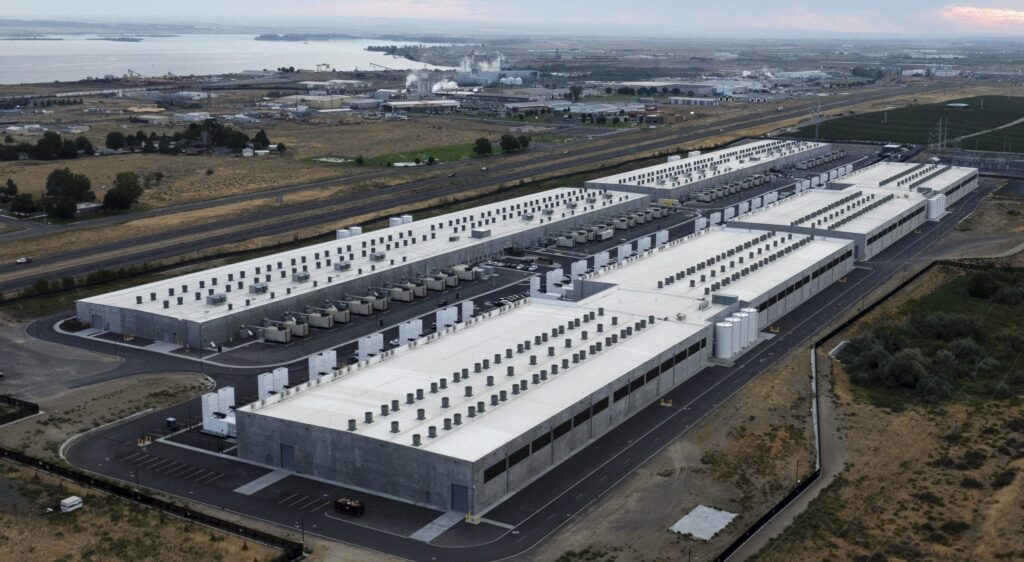
Top lawmakers call for data center transparency
INDIANAPOLIS (WISH) — Consumer advocates said they hope recent comments by top state Senate leaders about data centers result in changes to state law.
During the Indiana Chamber of Commerce‘s annual legislative preview earlier this month, Senate President pro tempore Rod Bray, R-Martinsville, said state and local governments should rethink how nondisclosure agreements are used surrounding data centers. Bray made those comments as part of a broader discussion surrounding economic development. He said, so far, data centers have been good sources of property tax revenue, but have brought few other economic benefits.
“We’re going to have to, locals and everybody, are going to have to rethink the nondisclosure agreements,” Bray said. “Those create a high level of distrust. When there is an unknown out there, the public fills it with lots of things that may or may not be accurate.”
Over the past few months, proposed data centers in Franklin and Decatur townships, the Martindale-Brightwood neighborhood ,and in Bray’s native Morgan County have drawn local opposition from across the political spectrum. Opponents have cited concerns ranging from environmental worries to impact on residential utility bills. Citizens Action Coalition Executive Director Kerwin Olson said nondisclosure agreements, or NDAs, are common in commercial agreements, but often end up blocking information that’s in the public interest. He said NDAs are designed to protect sensitive business information, such as proprietary technology, or trade secrets, which a competitor might use to gain an advantage.
“When folks learn about nondisclosure agreements, especially ones executed by their local officials, who are there to represent them, then they get extremely suspicious about what these folks have to hide,” Olson said.
Olson said he’s not surprised by Bray’s comments. He said he suspects Bray and other lawmakers are hearing extensively from their constituents about data centers. He said he appreciates Bray for appearing responsive to those concerns.
If Bray’s comments do foreshadow legislation for the 2026 session, Olson said he would like to see legislation to make public basic information about proposed data centers, such as the size, expected electricity and water use, noise, traffic and pollution levels while still protecting true trade secrets.
“No one’s suggesting that company secrets, trade secrets, that sort of thing should be public, but the public should be informed about what these projects are,” Olson said. “We’d like to see the General Assembly take a leadership role, if you will, with respect to that because lots and lots of things in the economic development world are shrouded in secrecy. That builds distrust.”
Senate Minority Leader Shelli Yoder, D-Bloomington, said Democrats look forward to seeing what kind of legislation results from Bray’s comments. Bray and Yoder’s House counterparts, Speaker Todd Huston, R-Fishers, and Minority Leader Phil GiaQuinta, D-Fort Wayne, cautioned against moving too aggressively against data centers. GiaQuinta said he has not had any problems so far with a data center under development for Allen County. Huston said data centers can bring indirect economic development, even if they don’t directly employ many people. He said companies will build close to data centers to reduce lag time for their AI systems.
The 2026 legislative session begins on Monday. Because it’s starting early so that lawmakers can redraw Indiana’s Congressional district maps, Huston has said the legislature plans to wrap up its work by the end of February instead of mid-March, which is when non-budget year sessions normally end.
About The Author

You may also like
-
Indiana DNR launches rewards program for Hoosiers to explore state parks and wildlife areas
-
Indiana State Police locate third vehicle involved in I-465 school bus crash
-
IMPD busts suspected Spice dealer, seizes 22 guns and $89K
-
1 child dead, another injured after hit-and-run on Indianapolis’ northwest side
-
Fever GM defends fans, says criticism has ‘no basis in reality’