
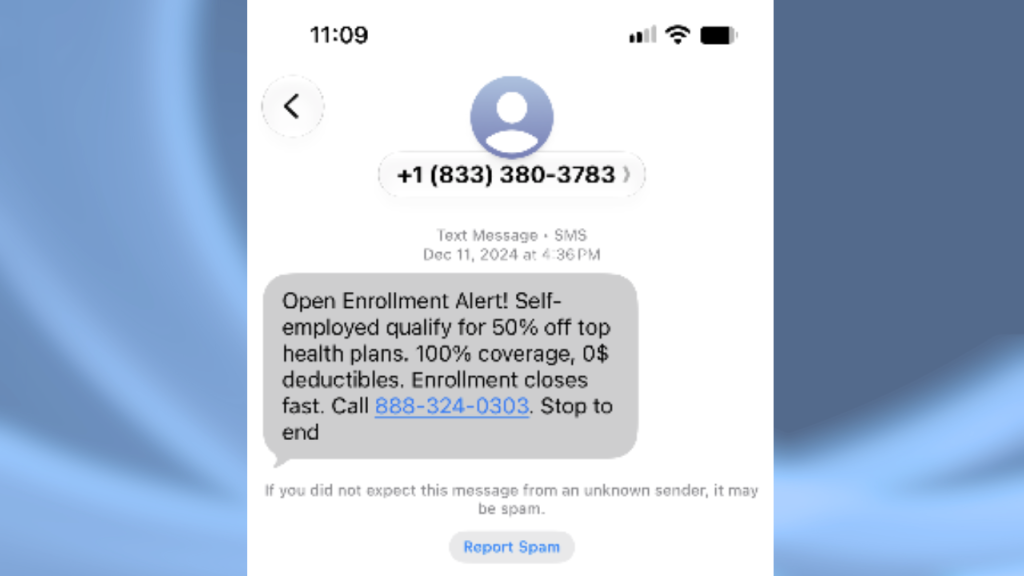
INDIANAPOLIS — Open enrollment is underway for Medicare and many other insurance providers.
Scammers know this and experts say they’re ramping up their efforts to steal your information.
Typically, the scammer will send a text message about open enrollment, giving you a phone number to call or a link to click.
Medicare and insurance carriers are not going to text you out of the blue, unless you’ve opted in for certain communications.
The State Health Insurance Assistance Program (SHIP) in Indiana is already seeing an increase in open enrollment scams.
“One of the newer things like we’re seeing this fall already is individuals receiving text messages as well as phone calls from scammers saying, ‘Hey, log on to this particular website, and you can change your plan from here,’” Ben Hudson, Medicare training director for the SHIP said. “Unfortunately, those websites or the direct links that are in the text messages end up taking you to websites that may look legitimate on surface level.”
The fake websites are designed to steal your personal information, especially your Medicare number.
“Your Medicare number can generate millions of dollars in fraud just off one Medicare number potentially,” Hudson said. “Even more so if a fraud than if a fraudster had access to your Social Security number.”
Scammers and dishonest medical providers can file fraudulent healthcare claims and bill Medicare.
Fraud, mistakes and abuse cost Medicare an estimated $60 billion each year.
“If you don’t understand something on your Medicare statement, you have the right and responsibility to call that provider and find out what that charge was for,” Nancy Moore with Indiana Senior Medicare Patrol said.

You can protect yourself by typing Medicare.gov into your browser and click on Find Plans.
If you don’t have Medicare, go through your employer’s portal or type in your insurance carrier’s website.
“Make sure it is the actual website for Humana, Anthem, United, just double-check on that,” Hudson said.
Because of all the healthcare data breaches, the scammers may know a lot about you include your name, doctor, and your medical history.
“1-800-452-4800 is our main hotline,” Hudson said. “We actually have a call center of Medicare-trained counselors at the Department of Insurance building in Indianapolis. But anyone across the state can give us a call.”
You can also call 1-800-MEDICARE if you’re not sure if a text, email or phone call you received is legitimate.
Report Medicare fraud to the Health and Human Services Office of Inspector General online [oig.hhs.gov] or at 1-800-HHS-TIPS (1-800-447-8477). It helps them track down the scammers and try to stop them.
If you suspect Medicare fraud, call your health care provider or Medicare plan and ask for an explanation. If you aren’t satisfied with their response, call your local Senior Medicare Patrol [consumer.ftc.gov] for help filing a report, or call Medicare at 1-800-MEDICARE.
About The Author

You may also like
-
Suspect arrested in gas station fight that left 18-year-old dead
-
Ex-IPS teacher indicted on battery charges involving students with disabilities
-
1 person critically injured in northwest side shooting
-
Mom of kids killed by death row inmate asks Parole Board to deny clemency
-
Multi-car pileup leaves woman dead on I-465 near Keystone Ave