
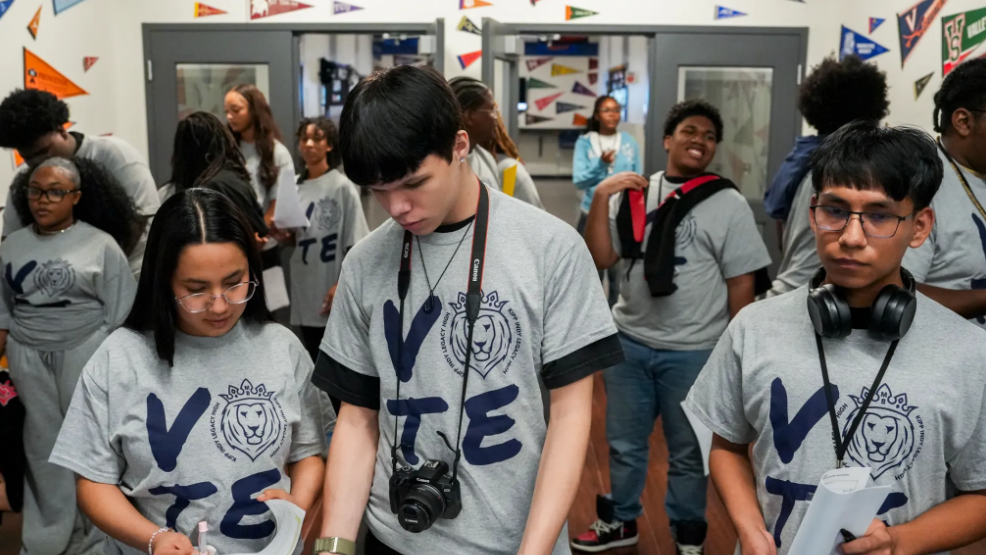
(MIRROR INDY) — When Angel Brown thinks about America, she worries today’s political leaders are setting the country back.
The 16-year-old voiced her frustration with the Trump administration’s approach to immigration and the fear it’s stoked among Black and Latino families. To the teenager, it feels a lot like the periods of segregation she’s studied in school.
“I kind of hate it,” Brown said. “A lot of the kids in school don’t really look at people for ethnicity or their skin color.”
Many of Brown’s classmates at KIPP Indy Legacy High School share her concerns. When asked to reflect on America today, the teens said they feel discouraged by the current political rhetoric. But they also feel grateful for their constitutional right to speak freely.

“It feels pretty good to have all of the freedoms to criticize the government,” 16-year-old Jamari Gunartt said. “To have that right to criticize even your own party.”
As America celebrates its 250th year, the young people expressed conflicting thoughts about what it means to be an American today. Some reflected on the country’s history and say they see real progress from the days of slavery and segregation. Others said they still have real concerns about divisions in the United States and how people are treated based on their race and gender.
The teens also said they’re worried about inflation, housing and the effect of tariffs, and added that they’re ready for new leadership — one representative of younger Americans.
“What about the younger people?” 16-year-old London Simmons asked. “We have to grow up and be in an environment with these laws that we didn’t even know nothing about because we didn’t vote for them.”
Teaching U.S. history
Patrick Newton, the kids’ U.S. history teacher, said he doesn’t shy away from difficult conversations in class. He tries to link what kids are learning about America’s founding to what’s happening now.
Students have significant fears about systemic racism and the presence of U.S. Immigration and Customs Enforcement agents in Indianapolis, Newton said. As their teacher, he tries to get students thinking about the change they’d like to see and provides resources for acting on it.
“It’s really a challenge that sometimes kids are pretty pessimistic,” Newton said. “It’s really just trying to validate kids’ feelings, but also being like, ‘Hey, we could do stuff, like register people to vote.’”

Discussions of history and race in schools have become a political flashpoint in recent years.
Newton said KIPP leaders have been supportive of his teaching, acknowledging that not every educator in his field has been so lucky.
Dozens of states have taken steps within the last five years to limit how teachers take up discussions of racism and sexism. A 2023 survey of American teachers found 65% of respondents decided on their own to limit class discussions of political and social issues.
“There’s a lot of history teachers across the country that if they talk about certain issues like this, they’ll get in trouble,” Newton said. “I’ve heard that from my teacher friends where they have to kind of beat around the bush when they talk about slavery or they talk about immigration.”

This year, Newton said, he’s making an effort to encourage more classroom consensus discussions — where teens are prompted to hear and consider all sides of an argument — over debates.
He hopes it counterbalances some of the heated discourse teens are surrounded by on social media.
“A lot of it is just breaking habits because a lot of kids are competitive,” Newton said.
‘The country of change’
Newton’s students — who aspire to be America’s next nurses, veterinarians and psychologists — said they wish there were more representation of young voices in government today.
“I feel like a lot of older people and people in charge are still stuck in the way things used to be,” 16-year-old Da’mari Thomas said. “Us, younger people, we know how to come together.”
Teresa Patrick, 16, said she tries to stay focused on the present and what she can do to make a difference. For Patrick, that means using her voice to advocate for change.
“It’s recommended for us to protest, have a petition, have a boycott so we can all have a right to have our voice heard,” she said.
Marquise Hill, 16, said he mostly tries to avoid big political conversations.

Instead, he focuses on taking small actions to better his community. That includes volunteering at his community center and providing food to his unhoused neighbors.
“If you focus on too many other things, they might slow you down,” he said. “You’ve got to mostly focus on yourself.”
Meanwhile, Ivan Moreno said he thinks change is possible. It could just take a little time.
The 17-year-old pointed to examples where Americans have overcome their differences. Over time, he said, laws, government and people have changed.
“Whether it be good or bad,” Moreno said. “America will always be the country of change.”
This story, and ArcFest 2026 – a festival centered around democracy, justice and freedom of expression, are presented as part of a national effort by local newsrooms to reflect on the 250th anniversary of the Declaration of Independence.
Register for ArcFest 2026 : https://fpinews.org/arcfest/
Read USA@250 coverage from other newsrooms : https://theajp.org/us250-local-journalism-series/
Mirror Indy, a nonprofit newsroom, is funded through grants and donations from individuals, foundations and organizations. Sign up for our free newsletters.
Mirror Indy reporter Carley Lanich covers early childhood and K-12 education. Contact her at carley.lanich@mirrorindy.org or follow her on X @carleylanich.
About The Author

You may also like
-
Buc-ee’s set to open in Greenwood by 2028
-
Man arrested in Elkhart after peering into school windows and hiding in St. Joseph River
-
New program helps attorneys open practices in legal deserts
-
INDOT proposes $5 million in Central Indiana transportation projects
-
Report: Colts WR Alec Pierce to miss ‘several weeks’ with heel injury