
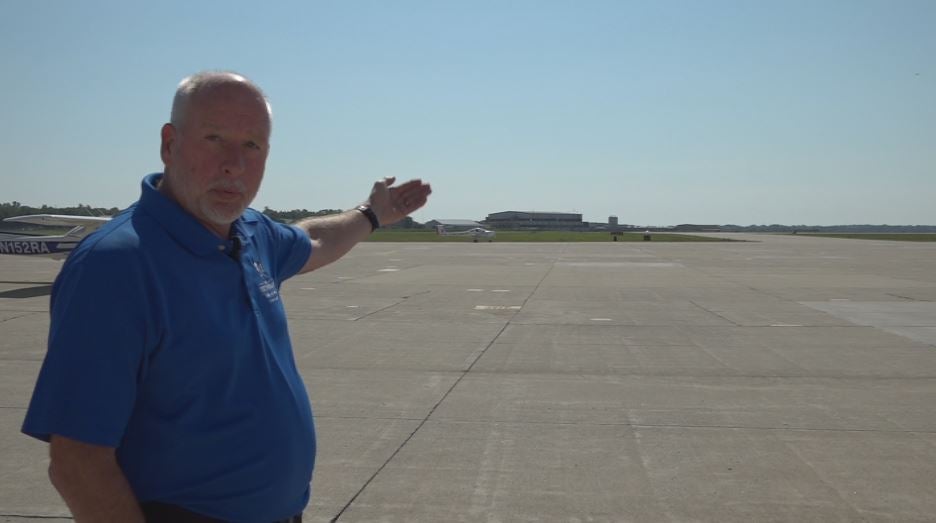
WISH Colbert: We got strange order to excort an aircraft
TERRE HAUTE, Ind. (WISH) — Col. Chris Colbert and his pilots felt the shift immediately on the morning of Tuesday, Sept. 11, 2001, at Terre Haute Regional Airport.
The Racers of the 113th Fighter Squadron had returned two days earlier from air combat training in Nevada. Colbert, then the squadron’s operations officer, was in a morning meeting with leadership when a knock at the door changed everything.
“They said, ‘Hey, you guys might want to come see this on TV,’ and said that an airplane had run into one of the towers in New York,” he said in a recent interview. “Everyone’s first thought was that’s really weird for maybe a small airplane to hit one of the Twin Towers. That’s very strange. There might be something else going on. So right from the beginning, I think people had a feeling that this might not be good.”
The unit moved into action as it watched United Airlines Flight 175 hit the South Tower.
The squadron served as the flying unit of the 181st Fighter Wing, which is now the non-flying 181st Intelligence Wing. Colbert said the unit was one of the few Air National Guard groups to store live munitions at a civilian airport. His commander ordered him to find a wingman and prepare for launch. Colbert chose Tom Sims, an American Airlines pilot, because Sims had experience identifying civilian aircraft.
Colbert and Sims took off in F-16 fighter jets equipped with 20mm cannon training rounds. While less powerful than combat rounds, the ammunition could still take down a plane. The jets reached supersonic speeds and arrived over Chicago within eight minutes.
“People say, ‘Well, why did you go to Chicago?’ Well, the two tallest buildings in the United States weren’t standing anymore, and the next tallest building is in Chicago,” he said.
The pilots spent hours patrolling Chicago’s airspace and refueling from a tanker aircraft. Colbert then heard a radio call: “Racer One, Chalice.”
Chalice was the callsign of an airborne warning and control plane.
“When they called us, they said that there was an Angel One flight that might need an escort,” he said. “And neither my wingman or I knew exactly what that meant.”
“He gave us directions to intercept Angel One flight,” Colbert said. “So it wasn’t until we got a little bit closer, like within about 10 miles, you could see the airplane from far away. It had a little bit of glistening to it, the way it was shining at that time of day. We could tell it was a big airplane, and from our radar, we could tell that it was going really fast. It was going almost the speed of sound. As we get a little bit closer, I could see the colors, and they were blue and white.”
Angel One was Air Force One.
President George W. Bush had been in Florida that morning when he learned of the attacks. After making a statement, he flew to Barksdale Air Force Base in Louisiana to offload personnel and take on supplies, then moved to Offut Air Force Base in Nebraska. Bush left Nebraska late that afternoon to return to Washington, requiring a fighter escort.
Colbert and Sims escorted the president for about 20 minutes across Indiana and into Ohio. They flew over the north side of Indianapolis, leaving contrails and sonic booms. Another group of fighters took over in eastern Ohio to finish the trip to the capital.
During the flight back to Terre Haute, Colbert began to process the day. A former history teacher, he remembered Abraham Lincoln’s 1838 speech to the Young Men’s Lyceum in Springfield, Illinois: “Shall we expect some transatlantic military giant, to step the Ocean, and crush us at a blow? Never! — All the armies of Europe, Asia and Africa combined, with all the treasure of the earth (our own excepted) in their military chest; with a Buonaparte for a commander, could not by force, take a drink from the Ohio, or make a track on the Blue Ridge, in a trial of a thousand years.”
Colbert said, “I realized that day that somebody had taken a drink out of the Ohio River. They had placed a track on the Blue Ridge Mountains, and we would never be able to say that again.”
Colbert flew more defensive missions in later days. He flew combat missions over Afghanistan and Iraq before retiring in 2019.
Colbert praised the military for its response to a situation it had never practiced. He said he worries that the fighter fleet is smaller now than it was in 2001, but noted the current planes are more capable. He asked Americans to remember the families of people who died on September 11 and the unity that followed the attacks.
“I would hope that, when this country is called to action because of bad people and wrongdoing somewhere in the world, that we would join together,” he said. “And if September 11 can no longer provide an example of that, then I begin to fear seriously about our nation. But, I think it’s still there.”
About The Author

You may also like
-
Trump promises $5,000 ‘dividend’ to citizens during midterm convention speech
-
Rain & storm chance continues Thursday; Friday football still looking good
-
Hamilton County traffic stop leads to arrest in Anderson homicide investigation
-
Indianapolis police arrest two juveniles following pursuit and handgun seizure
-
Pedestrian dies after being struck by vehicle on West Southport Road